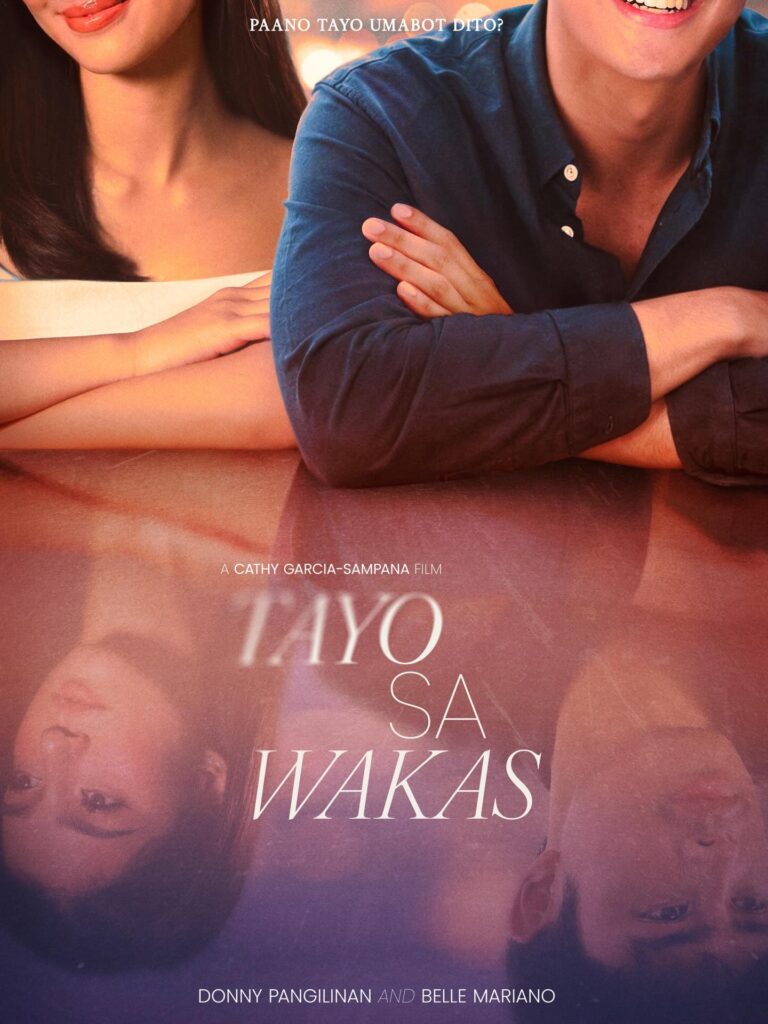
Tayo sa Wakas is not the film that pushes the boundaries of contemporary Philippine cinema.
While a new generation of directors and writers are exploring fresh storytelling approaches,
reframing familiar themes through more inventive and nuanced forms, this film feels anchored in
a formulaic structure, struggling to situate itself within an evolving cinematic landscape.
Star Cinema has long played a significant role in shaping mainstream Filipino cinema, but there
is a sense of repetition here that draws heavily from its own legacy. Tayo sa Wakas attempts to
position itself as a classic romantic drama, but in doing so, it ends up echoing familiar templates
seen in films like One More Chance(2007) and The Hows of Us(2018), rather than offering a
distinct voice of its own.
There are moments where the dialogue is meant to land with emotional weight, but they often
feel delivered rather than lived. While Donny Pangilinan and Belle Mariano show potential, it is
unclear whether the limitation lies in direction, material, or casting choices that do not fully serve
their strengths. They appear committed to their roles, but the emotional peak the film reaches
for often feels restrained. In contrast, Joross Gamboa ( aka the best supporting actor in every
Star Cinema film) delivers a standout performance, bringing a natural ease that elevates every
scene he is in.
That said, the film does elicit emotion but perhaps not in the most organic way. I found myself
crying, but more from expectation than from genuine emotional buildup. The film seems intent
on engineering its emotional impact rather than allowing it to unfold naturally.
Tayo sa Wakas arrives at a time when Filipino audiences are increasingly open to more daring
and innovative storytelling. Often, audiences only recognize what they want once they are
shown new possibilities. This is why it may be time to move beyond familiar narrative shortcuts
like illness, death, and other predictable emotional triggers and instead trust viewers with more
honest, less manipulative storytelling.
Philippine cinema has always been capable of more, and perhaps it is time for both filmmakers
and production companies to take greater creative risks, investing in stories that treat audiences
not just as consumers of emotion, but as intelligent participants in it